

Use the following tips and resources to jump start or improve your legislative visits and civic engagement knowledge. You can also visit in LAMPa website pages on “How to Make a Visit”, “How to Write a Letter to the Editor“ , “How to Write a Letter“, and ELCA Photo/Video Release. As always, LAMPa staff are ready to help.
INDEX OF TOOLS:
WHY VISIT YOUR LEGISLATORS?
Every year issues come before the state legislature that are of concern to ELCA Lutherans and those whom we serve through our congregational ministries, synods, Social Ministry Organizations, Seminaries, Colleges and outdoor ministries.
SETTING UP A MEETING
VIRTUAL VISITS
During a time of physical distancing when policy makers are less able to be out in their districts, it is important that constituents take opportunities to communicate their experience and opinions about the heightened public health and economic challenges. Learn about setting up virtual visits.
TALKING TO LEGISLATORS
Always be up front in your communications. If you don’t know the answer to a question posed to you during a visit, say “I’ll find out.” It’s okay to tell them you will email or call with the information they are requesting.
WHAT YOUR LEGISLATORS MAY NOT KNOW
AFTER THE MEETING
RESOURCES
“Government and Civic Engagement in the United States: Discipleship in a Democracy”. The ELCA has adopted this social message on government and civic engagement. This writing project was requested by the 2019 Churchwide Assembly and was adopted in June 2020 by the ELCA Church Council [CC20.06.17]. To help dig into the text, there is a Study Guide, along with a Leader’s Guide for those facilitating groups. A Spanish translation can be downloaded here.
Study Guide: Discipleship in a democracy: How should Lutherans Be Involved in politics?
Download a study guide for “Discipleship in a democracy,” which appeared in Living Lutheran‘s October 2020 issue. The free pdf includes six pages of discussion questions and a copy of the article.
Being a Public Church: Guidance for churches & clergy participating in the electoral process – Lutherans understand that governments are a means through which God can work to preserve creation and build a more peaceful and just society. As a public church, we have a responsibility to address issues that affect our neighbors in communities throughout the world. Through advocacy efforts, ELCA members and other Christians can work through governmental channels on behalf of biblical values. Participating in the electoral process is one way in which ELCA members live out the public witness of advocacy.
ELCA Advocacy – ELCA advocacy works for change in public policy based on the experience of Lutheran ministries, programs, and projects around the world and in communities across the United States. Our faith calls us to learn more and speak out on issues affecting our vulnerable neighbors and the forces threatening creation.
In conjunction with ELCA World Hunger and ELCA Advocacy, the 2019-2020 Hunger Advocacy Fellows prepared the “Advocacy 101 for Young Adults: When Faith Meets Public Policy” resource. Split into five sections, each contains activities and an audio component. The guide “…can be used by individuals or by groups such as college campus ministries, seminary student groups or Bible study groups for parents and young professionals. It is designed for people who find their home in the Evangelical Lutheran Church in America. Other Christian denominations may also find this resource insightful, and certain sections can speak across faith traditions and age groups.”
Search these resources for information that will educate and equip you to be a more effective advocate.
Sign up from to receive updates including Advocacy Connections, our monthly e-news, and Action Alerts at impactful moments.
Current Federal Action Alerts are available in the Action Center.
Join the conversation through social media @ELCAadvocacy and #ELCAadvocacy.
Find information and tools on the blog and resource page.
Advance the right to vote for all citizens in the upcoming election with the ELCAvotes initiative. Great tip sheets on registration and Get Out The Vote drives plus more are available in the ELCA Civic Engagement Guide.
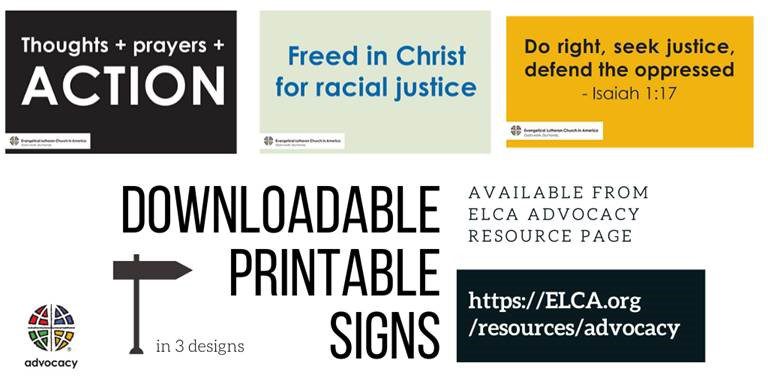
Downloadable Printable Signs from ELCA Advocacy.
New Civic Engagement Primer and Study Guide Available – A guide, produced by the Pennsylvania Council of Churches, to help discuss faithful citizenship within your own congregations, regardless of whether your congregation leans to one end of the political spectrum or the other, or is a true mix of folks from across the spectrum. The Pennsylvania Council of Churches has long believed in our call as Christians to be faithful citizens, participating in the public square in ways that support God’s call to love our neighbors as ourselves (without defining neighbor as only those in our affinity group) and to treat others as we wish to be treated (known as “The Golden Rule”). The Council observed there appears to be much confusion concerning history, our government systems, and what we can do as faithful citizens and as congregations. This guide provides educational resources to remind us how our government works and how we can recognize a problem to be addressed, or legislation we would like to see passed, making our voices be heard. Knowledge of these systems and how to work within them is essential if we are to engage in ways that are constructive and successful.