

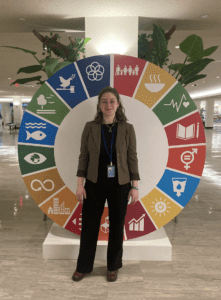
 LAMPa Advocacy Fellow Daniella Garber joined ELCA colleagues in the Lutheran Office for World Community for the United Nations Commission on the Status of Women during Women’s History Month. She shares her takeaways in this reflection, published on Substack:
 The theme of CSW this year was “ensuring and strengthening access to justice for all women and girls, including by promoting inclusive and equitable legal systems, eliminating discriminatory laws, policies, and practices, and addressing structural barriers.” What struck me about this theme is that it’s about access in practice; not just what the law says, but whether the law is actually accessible to the people who need it.
The Lutheran World Federation, a global communion of 154 Lutheran churches in 99 countries, representing more than 78 million people, signed statements to the Commission alongside ecumenical partners. The LWF statement named barriers that keep justice inaccessible: poverty, illiteracy, restricted mobility, sexual and gender-based violence, and social stigma. The LWF called on member states to eliminate discriminatory laws, build survivor-centered justice systems, and center the voices of women from marginalized communities in the reform processes meant to serve them.
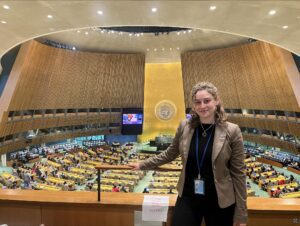 Here in the U.S., it can be easy to think of the UN as something that deals with problems in other countries—places more impoverished or unstable than ours, but that’s not the full picture. Many of the issues deliberated at the UN are live issues here at home, and the U.S. is not always a leader when it comes to women’s rights.
During one of the panels, Jeff Jordan, an ELCA Hunger Advocacy Fellow based in Washington, D.C., highlighted a topic that could affect women in the US in the near future: Right now, the U.S. Senate is debating the SAVE America Act, which would require documentary proof of citizenship to register to vote. Supporters say it’s about election security, but the evidence tells a different story.
 Noncitizen voting in federal elections is already illegal and rare; states already have systems in place to prevent it. What this bill would do is create new barriers for millions of eligible American citizens. 84 percent of women who marry change their surname, meaning as many as 69 million American women do not have a birth certificate with their legal name on it and thereby could not use their birth certificate to prove citizenship. Nationwide, over 21 million Americans lack easy access to the required documents, and at least 3.8 million don’t have them at all. Better solutions exist that strengthen election integrity without creating barriers to access for eligible voters.
The ELCA strongly supports voting as an expression of faithful citizenship, and many of our congregations literally serve as polling locations. Restricting ballot access is a direct concern, and Lutherans are encouraged to contact their senators as this bill is being debated.
This issue is a domestic example of the theme of CSW70: ensuring access to justice. The communities most at risk under this bill are exactly the communities the LWF named as those most often failed by systems that were supposedly designed to protect everyone equally.
Hunger is another issue that disproportionately affects women, both in Pennsylvania and across the country. Food insecurity in Pennsylvania has increased by 44 percent over just two years. More than 1.7 million Pennsylvanians are facing hunger, and LAMPa’s partner ministries are reporting record numbers of neighbors coming through their doors. According to the USDA, rates of food insecurity are higher than the national average for households headed by a single woman with children and in households with women who reported living alone. Historically, women are disproportionately affected by socioeconomic disparities and continue to outnumber men in documented cases of food insecurity in what has become known as the gender gap in food insecurity. In Pennsylvania, LAMPa and Lutherans across the state work to fight hunger through both feeding ministries and policy advocacy work.
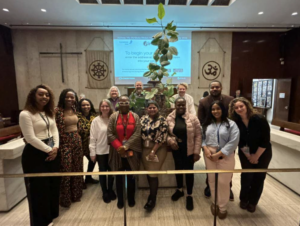 Although my entire experience at CSW70 was transformative, what moved me most was the experience of sitting in community with Lutheran women from all over the globe who had traveled enormous distances to insist that their governments be held accountable to the dignity God has given every person. We all came from different countries, different native languages, and different struggles, but we were united around the same conviction: that every person, every woman and girl, deserves to participate fully in the decisions that shape their lives.
I’m grateful to be part of a community that shows up for this work here in Pennsylvania and around the world.”