

 In early May, I had the opportunity to travel to Washington, D.C., alongside about 40 ELCA members to participate in the Churches for Middle East Peace (CMEP) Joint Advocacy Summit. Hosted in part by ELCA Witness in Society (WiS) Senior Director Rev. Amy Reumann and Middle East Policy Program Director Sasha Ghosh-Siminoff, the summit brought together about 300 Christians from more than 28 states. We gathered with a shared commitment to human dignity for Palestinians and Israelis, raising a unified Christian voice for peace and justice in the Middle East.
The summit was a powerful time of learning, preparation, and advocacy. During our pre-summit Lutheran gathering, we heard from ELCA Service and Justice Executive Director Rev. Khader El-Yateem, MENA Regional Associate Shadin Nassar, and Sumud Program Director Maddi Froiland. Their talks grounded us in the realities facing communities in the region. Following the pre-summit, El-Yateem delivered a powerful keynote for the first summit session.
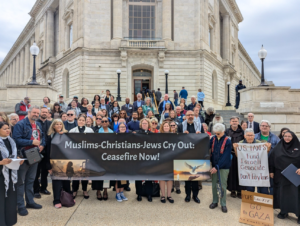 On the second day, I attended a breakout session on Christian Zionism featuring a panel that included Maddi Froiland. ELCA leaders and staff contributed to multiple panels and talks throughout the summit. We heard from a wide range of compelling speakers, including Rev. Munther Isaac of the Evangelical Lutheran Church of Jerusalem and the Holy Land (ELCJHL), Palestinian poet Mosab Abu Toha, student activist Mohsen Mahdawi, and author Peter Beinart, and many others.
One moment that stayed with me came from Orthodox nun Mother Agapia Stephanopoulos, who said, “When people hear the message, they will act.” That idea stayed with me throughout the remainder of the summit and after leaving D.C. It reminded me just how powerful information and storytelling can be. Hearing directly from people impacted by the violence in Gaza affected me in a deep and visceral way. It reinforced that so much of this work—working toward change—is rooted in listening, connecting, and sharing stories that move people to action.
The day concluded with an advocacy training session, followed by breakout sessions where I had the opportunity to connect with other Pennsylvania-based advocates and prepare for our time on Capitol Hill.
On the final day, we gathered for a prayer breakfast at the Lutheran Church of the Reformation. Bishop Nathan Pipho of the ELCA New England Synod offered a sending prayer as we prepared for Advocacy Day. we then spent the day on Capitol Hill meeting with representatives, senators, and legislative staff.
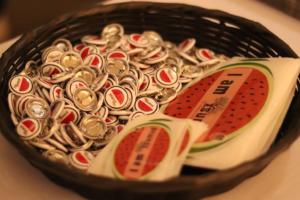 In our meetings, we advocated for an end to U.S. weapons sales that contribute to harm against Palestinian civilians and urged members of Congress to take action to address escalating settler violence and illegal Israeli settlements in the West Bank. We also called on elected officials to support reopening the humanitarian corridor between Gaza and the East Jerusalem Hospital Network. Augusta Victoria Hospital, supported by the Lutheran World Federation, is part of this network and serves as a vital provider of care for Palestinians, offering specialized services that are unavailable elsewhere. Since 2023, patients in Gaza who need this advanced medical treatment have been unable to reach Augusta Victoria and the other East Jerusalem hospitals, despite the urgent and ongoing need.
I am deeply grateful for the opportunity to learn, connect, and advocate alongside so many committed individuals. Faith-based advocacy is especially meaningful to me because it allows us to connect with people across differences, rooted in shared values and the belief in the inherent value and dignity of every person. This summit not only better equipped me for these conversations but also reminded me that advocacy matters and that, even when progress feels slow, we can still see the needle moving toward meaningful change over time.